
Inheritance & Family
- Patients
- /
- Inheritance & Family
Most forms of HTAD are inherited in an pathogenic pattern. However, a few rare forms can be inherited in an autosomal recessive or X-linked pattern. Individuals can also develop aortic disease from a combination of environmental and weak genetic factors – called multifactorial inheritance.
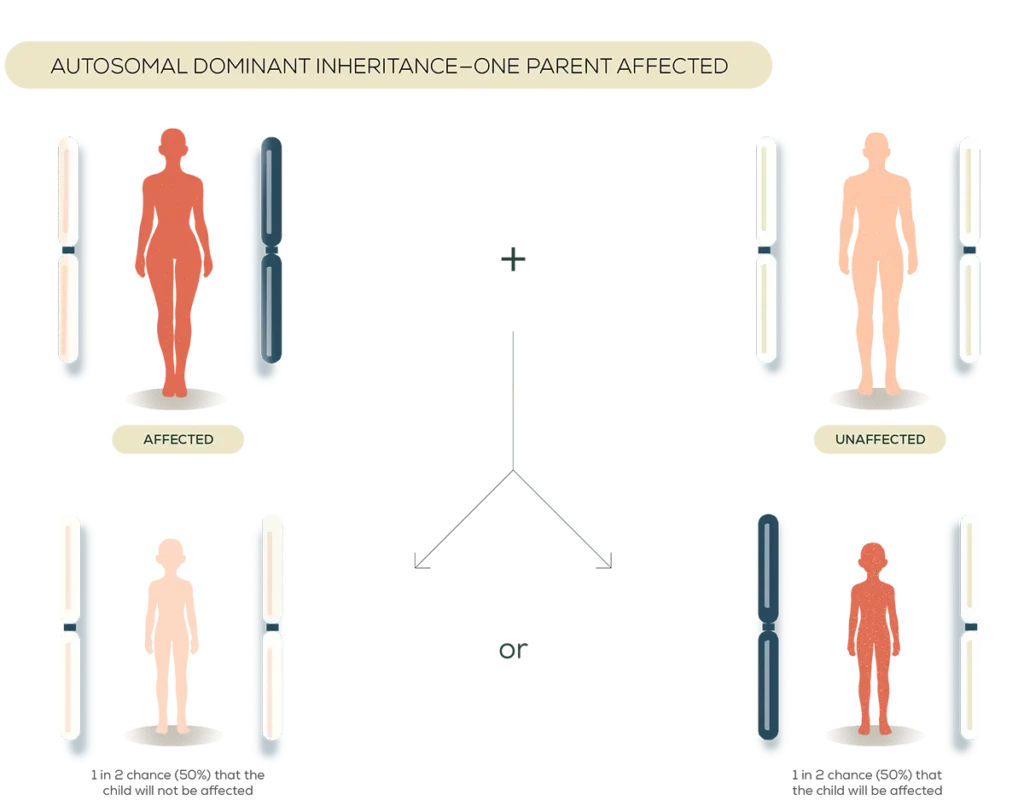
Pathogenic INHERITANCE
Most HTAD genes are inherited in an pathogenic pattern. For example every person has 2 copies of the FBN1 gene. If one copy has the usual gene sequence and the second copy has an pathogenic variant, then this person has Marfan syndrome. One FBN1 pathogenic variant is sufficient to cause disease.
If a person with a pathogenic HTAD condition like Marfan syndrome has children, there is a 50% chance to pass on the pathogenic variant (has HTAD) with each pregnancy. There is also a 50% chance to pass on the gene with the usual sequence (does not have HTAD).
VARIABLE PENETRANCE
Variable penetrance and variable expression: Even within the same family, the severity of disease can vary widely. Some individuals may develop significant aortic disease at a young age, while others may have mild or slowly progressive changes later in life. This means that not everyone who carries a pathogenic variant will develop the same degree of aortic disease, and some individuals may not develop noticeable disease until later in life.
DE NOVO
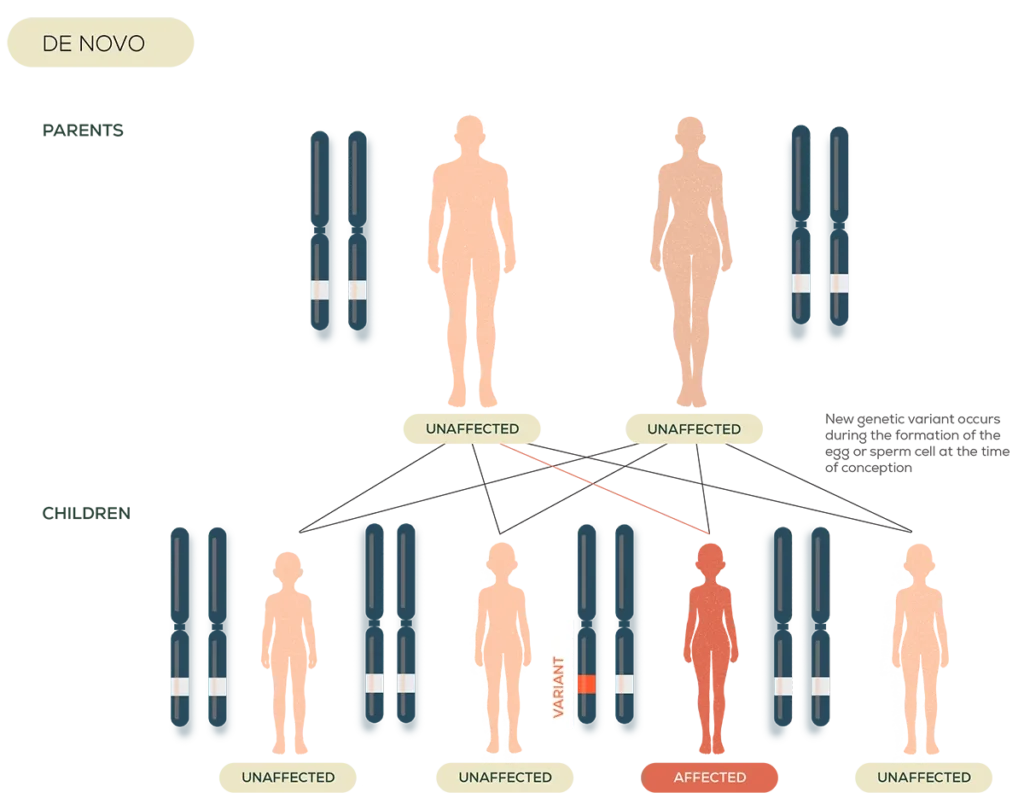
About one-third of people with Marfan or Loeys-Dietz syndrome, and about half of people with vascular Ehlers-Danlos syndrome, are the first people in their families to have the condition. This means the variant arose as a new gene change at the time of conception. These changes occur naturally and are not caused by anything the parents did or did not do before or during pregnancy.
For a person with a de novo HTAD-causing variant, each child has a 50% chance of inheriting the pathogenic variant. For a person with a de novo HTAD-causing variant, each child has a 50% chance of inheriting the pathogenic variant—and therefore the associated HTAD condition—with each pregnancy. There is also a 50% chance that the child will inherit the usual copy of the gene and will not have the condition. There is also a 50% chance to pass on the gene with the usual sequence (does not have HTAD).
Other Inheritance Patterns
Autosomal Recessive
Two HTAD genes, EFEMP2 and SLC2A10, are associated with autosomal recessive inheritance.
Every person has two copies of each gene. A person who has a pathogenic variant in one copy and a usual sequence in the other is called a carrier. Carriers generally do not develop the associated HTAD condition. A person who inherits a pathogenic variant in both copies of the same gene will develop the condition.
When both parents are carriers of a pathogenic variant in the same gene, each pregnancy has a 25% chance of resulting in a child with the condition, a 50% chance of resulting in an unaffected child who is a carrier, and a 25% chance of resulting in an unaffected child who is not a carrier.
X-Linked
Three HTAD genes: BGN, FLNA and MED12 are located on the X chromosome. Biological females have two X chromosomes and therefore, two copies of the genes located on the X chromosome. Biological males have one X chromosome and one Y chromosome and therefore only one copy of the genes located on the X chromosome. For X-linked conditions, in general biological males are more severely affected then biological females. For example, people who have pathogenic variants in the BGN gene, biological males are more likely to have aortic aneurysms and dissections, and they typically occur at a younger age compared to biological females.
For a biological female who has X-linked HTAD, there is a 50% chance to pass on the X chromosome with the HTAD variant for each pregnancy, male or female. For a biological male with X-linked HTAD, all of their daughters will inherit their X chromosome containing the variant for X-linked HTAD. Their sons will inherit the Y chromosome and will not be affected with X-linked HTAD.
Multifactorial
The majority of aneurysms do not have a genetic basis; rather they occur due to a combination of factors. Some people/families may have weak genetic factors that in combination with environmental factors can cause aneurysms. For example, environmental factors may include health conditions like hypertension (high blood pressure), coronary artery disease (high cholesterol), smoking, age, traumatic injury, infections and inflammatory disease.
Dr. Shaine Morris, MD, MPH
Pediatric Cardiologist
Medical Director, Aortopathy and Cardiovascular Genetics Program, Texas Children’s Hospital
Dr. Shaine Morris discusses how participation in longitudinal research registries helps advance our understanding of Heritable Thoracic Aortic Disease (HTAD) from childhood through adulthood. She explains why following patients and families over time is essential to understanding disease progression, improving clinical care, and identifying opportunities for earlier intervention. Through initiatives such as the MAC Registry, patient and family participation contributes to the evidence needed to improve outcomes and inform future generations affected by HTAD.