



Diagnosing HTAD?
- Patients
- /
- Diagnosing HTAD?
Diagnosing HTAD involves bringing together information from a person’s medical history, family history, physical examination, imaging studies, and genetic testing. Because HTAD can be silent for long periods, diagnosis may begin with suspicion rather than symptoms.
HTAD should be considered in individuals who have:
- Enlargement or dissection of the thoracic aorta, particularly at a younger age
- A family history of aortic aneurysm, aortic dissection, or sudden unexplained death
- Physical features suggestive of a connective tissue condition
- Aneurysms or dissections involving arteries beyond the thoracic aorta
Imaging of the aorta
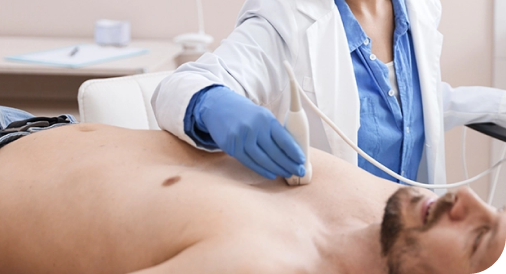
Imaging is essential to diagnose and monitor HTAD. Common tests include:
- Echocardiography (ultrasound of the heart) – often the first test
- CT scan or MRI – used to visualize the entire aorta and other arteries
Measurements are compared to expected values for a person’s age and body size. Even mildly enlarged aortas may be clinically important in HTAD
Genetic testing
Genetic testing plays a central role in HTAD diagnosis. A multigene panel is usually recommended, testing genes known to be associated with thoracic aortic disease.
Benefits of genetic testing include:
- Confirming a specific diagnosis
- Guiding surveillance and surgical thresholds
- Identifying which relatives are at risk
- Reassuring relatives who did not inherit the genetic change
Currently, pathogenic variants are identified in:
- Most individuals with Marfan or Loeys-Dietz syndrome
- About 20–30% of families with non-syndromic HTAD .
Family screening
If HTAD is diagnosed or suspected:
- First-degree relatives (parents, siblings, children) should undergo aortic imaging
- Genetic testing is recommended if a disease-causing variant is identified in the family
Family screening often detects affected individuals before symptoms develop, allowing preventive care.
Even when genetic testing does not identify a clear cause, HTAD cannot be ruled out. Some genetic contributors have not yet been discovered, and not all disease-causing variants are detectable with current tests. For this reason, imaging of first-degree relatives (parents, siblings, and children) is often recommended when thoracic aortic disease is identified in a family.
Early diagnosis allows for proactive care, including regular imaging, medical therapy to reduce stress on the aorta, and timely surgical intervention when appropriate. It also enables identification of relatives who may be at risk but have not yet developed symptoms.
FAQ
Eos blanditiis atque sit adipisci fugiat eum amet?
Lorem Ipsum is simply dummy text of the printing and typesetting industry. Lorem Ipsum has been the industry's standard dummy text ever since the 1500s,
Enim sit velit odit ex impedit placeat sed ipsum harum?
Lorem Ipsum is simply dummy text of the printing and typesetting industry. Lorem Ipsum has been the industry's standard dummy text ever since the 1500s,
Et assumenda dolorem est modi dolorem et quisquam?
Lorem Ipsum is simply dummy text of the printing and typesetting industry. Lorem Ipsum has been the industry's standard dummy text ever since the 1500s,
Ipsum est itaque enim id expedita quidem qui laborum voluptatem?
Lorem Ipsum is simply dummy text of the printing and typesetting industry. Lorem Ipsum has been the industry's standard dummy text ever since the 1500s,
Eos corrupti porro est magni quod qui autem est enim cumque?
Lorem Ipsum is simply dummy text of the printing and typesetting industry. Lorem Ipsum has been the industry's standard dummy text ever since the 1500s,